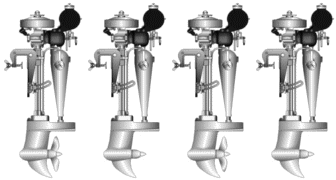
Interesting you mention stiffening ribs Charles. What needs stiffening in the cylinder head? I can see why you've asked this question as i've also pondered whether or not the fins do actually provide any strength/stiffness or if they do indeed provide a little bit of cooling.
If this were an FV or similar that we were talking about with those delicate half round cast tank mounts incorporated into the head, well that would be a different story, but what we're talking about here is a later square block cylinder head with quite beefy looking and flat mounted tank supports. Apart from lifting an outboard motor by its fuel tank whilst recovering or fitting the engine to the transom, the ideal point of balance for carrying one of these motors is by the drive tube, or heaven forbid one of those tacky looking carry handles that go around the drive tube that Keith hates so much.
4 bolts are obviously better than 2 when it comes to attaching a cylinder head onto a cylinder. Does that in itself make the head any stiffer or weaker? As keith has mentioned, a 2 bolt head was probably very prone to premature failure if that was ever the case.
The engine will of course go through a heat cycle at every use, and some of this residual heat ends up in the fuel tank via the cylinder head. A strange thing when you consider we're trying to keep heat away from fuel for obvious reasons despite the engine having an isolation pad between the tank and head. Would there be any more heat build up if there wasn't any fins on the head to begin with? (a bit like an early anzani pilot engine Keith) A seagull is a watercooled design after all is said and done.
I'm not sure that i would agree that what was advertised was EXACTLY what you ended up with. From what i've seen in many old seagull adverts there's a lot of mention about extensive testing that's already been done before a new engine is put out in general circulation. I can't imagine that British Seagull would allow themselves to be wide open to some discriminating letters from angry users saying their outboard motor has failed prematurely because of a small design fault. Development of any new design can take many different forms, and from what we've seen in the previous images this could easily be one such occasion where a few sneaky pictures of an "experimental" engine have made their way into a publication. Whether or not this was intended remains to be seen, but i remember Charles P saying something to the effect that he has letters from customers saying as much. This is not the sort of thing that anybody would want to be publicly known, but i'm fairly sure this kind of thing did happen and BS learned very quickly from it. There has been mention in the past with 1 piston ring fitted to pistons. Was this a sneaky way of BS trying to reduce their production costs somehow? Probably, but it didn't work very well did it, and so BS learned not to mess with something that worked well enough in its first instance.(not broken and didn't need fixing from a design point of view)
Remember that if these images are indeed genuine, then any motor in the line up prior to this would be slightly different as BS have just moved away from one design with the "little 40" etc. with a through bolt fixing, to a newer "sealed" water jacket. Late model LS and this new "experimental" are both presumably 64cc, so there's little change in cylinder specs apart from the water jacket at one end of the cylinder. Cylinder head design between the 2 motor types probably would vary a little bit, but not so that you'd notice from the exterior apart from earlier heads being non scripted and later heads having "DONT REMOVE". A late model LS by the looks of it has the same overall cylinder head design as this "experimental" 40. Does the cylinder head in any square block engine need to be strengthened/stiffened? Why do all of the other motors in the "little 40" range also have fins on their cylinder heads? I don't think this is a matter of strength or stiffening as such as there's plenty of older square block engines still running perfectly well today, same with many older SJM/P motors. It's just a design feature that stuck with the rest of the square block models. True, the physical size of some of these fins vary a little bit, perhaps for better cooling as i've suggested, but i wouldn't say it was for extra strength.
That wasn't broken so BS never needed to fix it. What DID need fixing was the earlier crankcases in the FV's with their newly introduced (re-designed) webbed part above the tiller. When you think about it, the fixed tiller provides a good handle to lift the motor by, and over time the crankcases broke as a result of these stresses placed upon it. Later on the tiller went to a tilting method which carries on in all the other motors both big and small.
Case in point with the "air cooled" little model 40 at the start of this thread i was interested in. I think this is all down to development and extensive testing on BS's part. Some design changes work very well, and some things don't.
Props are another design change.
3 blades or 4. We're all used to seeing a 3 bladed prop on an FV, but let's not forget that many of these little engines were only 55cc.
With a slightly larger displacement of 64cc as in the SJM/P etc. perhaps it was thought that a larger engine produced a bit more power (read into that what you will) but again i think this is all down to development and if you like improving on an older design. Maybe 4 blades on the prop was thought to produce a bit more thrust for better efficiency as there's a bit more power from the engine to spin it in the first place. Who knows for sure, but i think it's still down to development rather than change for change's sake.
Here's what you want to see with props.
It's not the best FV prop you've ever seen, and in truth its a bit battered but you get the general idea with these smaller props.
Enjoy